
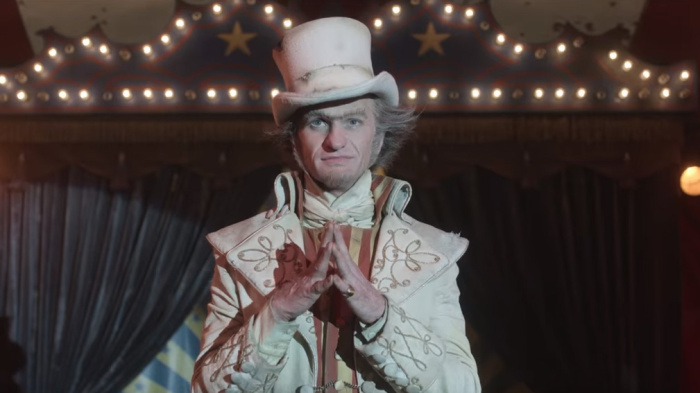
Lemony Snicket has heeded many warnings about the grim nature of his series centred on three resilient children with the most unfortunate of luck. Devilishly hunted for their inheritance by their greedy relative Count Olaf (Neil Patrick Harris), they narrowly escaped Season 1’s traps of underage matrimony, extreme hurricanes, and their exploitation as workers of a lumber mill that comedically resembled a gulag. With each new guardian they were haphazardly assigned to, they experienced the cyclical formula of adjusting to their new home only to encounter the Count in a new disguise so transparent it became a wonder that the adults fumbled over his treachery to the point of frustration. By the time Episode 4 wrapped up, it almost became gratuitous to binge on the misfortunes of three likeable but unlucky orphans.
This season follows a similar pattern of a new home, discovery (sprinkled with sporadic musical numbers and fourth wall suspensions), but this time around there are more clues to the mysterious fire that claimed the lives of their parents and their parent’s associates. The baddies scoff at literature and books and the goodies are inquisitive people who are determined to seek the answers. Victimhood does not solve any problems and sometimes the only way to move forward is to drag one foot in front of the other. With each reveal of how these events are all interrelated, we are thrust deeper and deeper into confusion about the secret organisation V.F.D. and its toxic tentacles that leave a blotch on every destination.
Entrenched in fantasy that can be farcical at times, there’s still an almost-too-real resonance with the political climate today. It’s questionable how the teachers at their boarding school are employed with little to no qualifications, and the classic trope of a wannabe artist unaware of their own lack of talent is painful yet entertaining. Episode 6 explores the extreme snooty, superficial standards of “fitting in” to the point of absolute ridicule (including a aptly named “Cafe Salmonella” restaurant that cannot account for even the most refined tastes). Rich people are villainous, but they maintain the status quo out of seemingly noble motivations because “if we give money to poor people, they won’t be poor anymore and we won’t have anyone to feel sorry for.” Mob psychology and the misinformation of facts in the media is especially poignant amidst Episode 7 and Episode 8 feeds into the bureaucracy of hospital administration where the main priority is not fighting disease but ensuring that all records are up to date as “paperwork makes the world go around.” Ending literally on a cliffhanger is Episode 9 set at an anachronistic carnival that satirises the treatment of “carnival” people on the fringes of society whilst simultaneously yearning for a more innocent era of entertainment and joy.
Before you become comfortable with solving the mystery, characters are sacrificed as brutally as a Westeros kingdom and clues are snatched away just as menacingly. Count Olaf is theatrical and as self-aware as he was in Season 1, but with a new array of characters (including the fashionably conceited Esmé Squalor–Lucy Punch), the debonair and dashing Jacques Snicket (Nathan Fillon) and promising librarian Olivia Caliban (Sara Rue), there remains some hope that the new series is more fleshed out with an extra two episodes.
By all means, hang onto hope in this series, but be wary that this is a series about children that’s certainly not a fairytale.
Don’t say they didn’t warn you.
Netflix
About The Author

You may also like
-
A Complete Guide To Marvel Phase 5 and 6
-
Married At First Sight Australia’s Couples Compatibility Ranking Revealed by a Relationship Expert
-
2022 Super Bowl TV Spots and Trailers: Doctor Strange 2, Lord of The Rings and more
-
WATCH: Netflix drops Outer Banks season 2 trailer
-
Gossip Girl RETURNS in first ever reboot trailer